If you are looking for concise yet accurate answers to the fundamental questions about the functional safety of components, systems, and industrial plants, you are in the right place. Discover the meaning of SIL and much more that is useful for daily operations, explored in depth and verified by our assessors, certified FS Engineers (TÜV Rheinland).
1. What is functional safety?
Functional safety is the ability of an industrial system to activate protection functions in the event of a failure or dangerous situations for operators or the environment. Functional safety is therefore what ensures that a device (for example, a sensor, an actuator, or an emergency valve) performs its function without errors (for example, stopping the machine when operators are in the immediate vicinity).
Functional safety is at the core of the IEC 61508 standard, which defines four SIL (Safety Integrity Level) levels, namely SIL 1, SIL 2, SIL 3, and SIL 4. Read the in-depth article.
2. What is the difference between functional safety and intrinsic safety?
Functional safety is the branch of engineering concerned with safety systems that use electrical, electronic, and programmable electronic (E/E/PE) technologies as a protective measure against risks during the use of a machine.
Intrinsic safety, on the other hand, is a design technique specific to environments characterized by explosion risk, aimed at limiting and preventing the ignition of flammable gases or dust by monitoring the energy and temperature of electrical circuits.
3. What does SIL mean and how is it calculated?
Safety Integrity Level (SIL) is the quantification of the reliability (or degree of reliability, ranging from 1 to 4) achieved by any object that performs a safety-related function. The greater the reliability, the greater the ability to fulfill functions that are critical for safety or for the availability of machines or plants.
There are three requirements that a safety system must satisfy:
- Systematic Capability, i.e. the degree of reliability in terms of product design, both hardware and software (where applicable)
- Architecture Constraints, i.e. constraints on the architecture of the object that affect its safety level
- PFDavg or PFH, i.e. the probability of dangerous random failures, whether on demand or on an hourly basis
The safety system may satisfy each requirement with a different SIL level (from SIL 1 to SIL 4); the overall SIL rating corresponds to the lowest of these levels.
The SIL level of a system must be calculated for each of the three requirements and is determined through a risk analysis, which evaluates the severity of the hazard, the frequency, the probability of failure, and the protection measures already in place.
Recommended in-depth study
SIL Level calculation4. How do SIL 1, SIL 2, SIL 3, and SIL 4 differ?
SIL levels differ according to several parameters; of particular importance is the average probability of failure on demand (PFDavg):
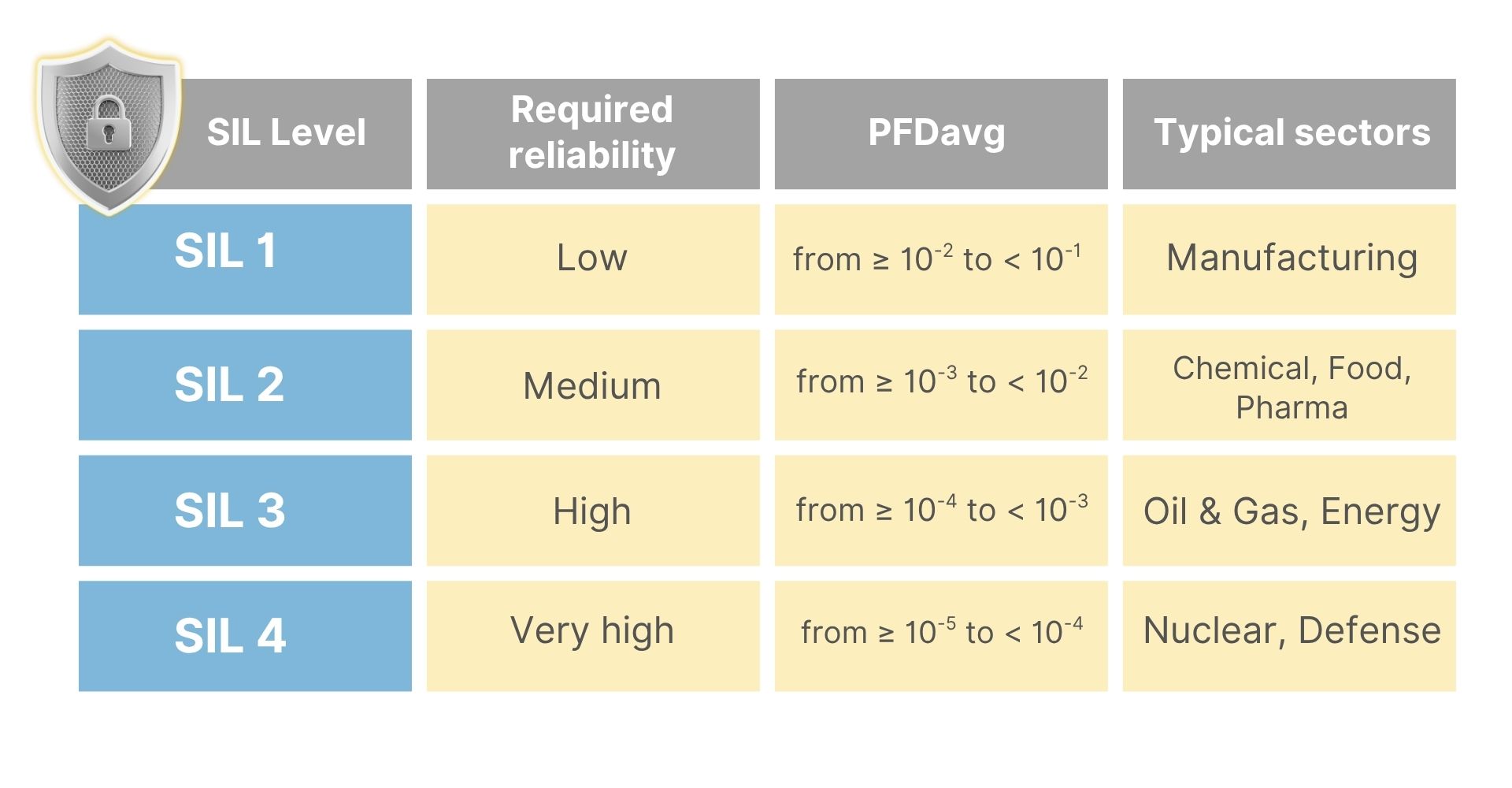
Reference SIL Values Table
5. What are the minimum requirements for SIL 2 or SIL 3?
SIL 2 and SIL 3 are the most commonly used levels in the industrial world.
To achieve SIL 2 or SIL 3, a safety function must comply with the minimum requirements defined by the IEC 61508 standards, as indicated in the Reference SIL Values Table above.
In addition, the regulations require the manufacturer to provide complete documentation (SRS, calculations, proof tests), independent verification of the device, and proper management of the safety lifecycle. Learn more.
